Call Now: +91-9810127011,+91-9999741959
Mail Us: nagpalengg@gmail.com

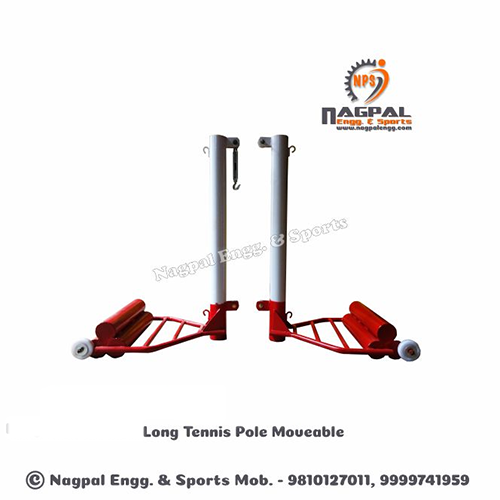
Movable lawn tennis poles, also known as freestanding or portable tennis posts, are designed for sports facilities that require a flexible tennis court setup without permanently drilling or installing ground sleeves. These systems provide the stability required to support and tension a tennis net while allowing the complete setup to be relocated when the playing area is needed for other activities. Movable Lawn Tennis Poles Manufacturers in Delhi offer portable and durable tennis net-post solutions for schools, sports clubs, multi-purpose stadiums, academies, recreational facilities, and institutional sports centres. They are particularly suitable for facilities that need adaptable court arrangements and efficient use of available space.
Unlike lightweight backyard systems, professional movable tennis poles use heavy-duty weighted bases, strong structural frames, caster wheels, and integrated net-tensioning mechanisms. Depending on the application, they can be manufactured from powder-coated or galvanized steel, heavy-duty aluminium, or multi-purpose adjustable components. At Nagpal Engineering & Sports, we provide movable lawn tennis pole solutions designed around court requirements, portability, stability, frequency of use, and multi-sport applications. Our systems can be selected for facilities where reliable net support and convenient relocation are equally important.
Movable lawn tennis poles are freestanding tennis post systems designed to support the tennis net without requiring permanent ground sleeves. Instead of being fixed directly into the court surface, the posts are mounted on heavy-duty bases that provide the necessary stability against the tension applied to the net.
These systems generally consist of vertical posts, weighted base frames, wheels or casters, net-tensioning winches, and net attachment components. The base may incorporate steel weights or other suitable counterweighting arrangements to prevent the poles from moving or leaning when the net is tensioned.
Movable tennis poles are particularly useful in multi-purpose facilities because they can be positioned for tennis matches and subsequently rolled away when the area is required for another sport or activity.
Movable tennis poles allow educational institutions to create tennis setups without permanently modifying multi-purpose playing surfaces.
Tennis clubs can use heavy-duty movable systems for training areas, temporary courts, or facilities where equipment needs to be repositioned.
Wheeled tennis poles can be rolled away when the same indoor space is required for volleyball, badminton, basketball, or other activities.
Training centers can use stable movable posts for regular coaching sessions, practice matches, and tournament preparation.
Universities, residential institutions, and corporate campuses can benefit from portable court equipment where flexible sports-space management is required.
Recreation facilities can install movable systems where tennis equipment needs to be assembled and removed according to scheduled activities.
Movable systems are suitable for temporary court arrangements where permanent ground installation is not preferred or practical.
As experienced Movable Lawn Tennis Poles Suppliers in India, Nagpal Engineering & Sports provides freestanding tennis post solutions designed for different sports environments. We understand that many schools, clubs, institutions, and multi-purpose sports facilities cannot dedicate a court exclusively to tennis. For such applications, movable systems provide an effective way to install the net while retaining the ability to clear the playing surface afterward.
Our movable tennis pole solutions can incorporate heavy-duty steel bases, caster wheels, vertical posts, net-tensioning winches, lacing bars, and suitable counterweight arrangements. Heavy bases help provide stability against the tension generated when the tennis net is tightened, while wheels allow staff to relocate the complete system with less effort.
For facilities requiring lower equipment weight, heavy-duty aluminium can provide a lighter alternative while maintaining a weighted base for stability. We can also provide multi-sport configurations where adjustable post heights allow the same system to support different sporting applications.
The appropriate movable lawn tennis pole depends on factors such as court surface, indoor or outdoor use, required mobility, frequency of use, desired stability, storage requirements, and multi-sport compatibility. Our aim is to provide practical solutions that combine structural strength, mobility, convenient operation, and long-term usability.
|
Specification |
Details |
|
Product |
Movable Lawn Tennis Pole |
|
Type |
Freestanding / Portable / Wheeled |
|
Regulation Net Height at Posts |
1.07 metres |
|
Typical System Weight |
Approximately 30–140 kg per pair, depending on design |
|
Main Materials |
Powder-Coated Steel, Galvanized Steel, Aluminium |
|
Steel Profile |
Up to approximately 3-inch / 80 mm square or round pipe, depending on model |
|
Base Type |
Heavy-duty weighted T-shaped or box frame |
|
Base Weighting |
Steel, sand, or other suitable counterweighting systems |
|
Mobility |
Heavy-duty caster wheels |
|
Wheel Type |
Lockable or flip-down caster configurations, depending on model |
|
Tensioning Mechanism |
Brass/steel ratchet or worm-gear winch |
|
Net Attachment |
Lacing bars, hooks, or tie-off points |
|
Finish |
Powder-coated / galvanized weather-resistant finish |
|
Multi-Sport Option |
Tennis, Badminton and Volleyball on suitable adjustable systems |
|
Applications |
Schools, clubs, academies, sports halls, institutions and recreational facilities |
Nagpal Engineering & Sports is a Movable Lawn Tennis Poles Exporter in Delhi, offering freestanding tennis post solutions for sports facilities requiring flexibility without permanent ground installation. Our movable systems can be suitable for schools, universities, sports clubs, academies, institutional facilities, recreational centers, and multi-purpose sports halls.
Professional movable tennis poles require more than simple lightweight frames. Their weighted bases must provide adequate stability against the tension generated by the tennis net. For this reason, our systems can be configured with heavy-duty steel or aluminium posts, counterweighted bases, caster wheels, and mechanical net-tensioning mechanisms.
Wheeled bases make the equipment easier to reposition when the sports facility needs to convert the playing area for another activity. Depending on the selected configuration, adjustable systems can also support multi-sport requirements involving tennis, badminton, and volleyball.
We focus on practical construction, suitable material selection, reliable tensioning arrangements, and convenient mobility. Each system can be selected according to the intended application, playing surface, frequency of use, required portability, and desired level of stability.
Steel is one of the most common choices for club, institutional, and demanding sports applications. Heavy-duty steel posts provide strong structural rigidity and can be combined with weighted bases to resist movement caused by net tension.
Powder-coated or galvanized finishes can provide additional protection against moisture and environmental exposure.
Aluminium provides a lighter alternative to steel. It can be useful where the equipment needs to be moved frequently while still requiring a rigid post structure.
Even with lightweight aluminium posts, the base needs sufficient counterweighting to provide stability when the net is tensioned.
Multi-purpose systems can feature telescoping or adjustable post sections with different height settings. Depending on the specific system, one pair of posts may be configured for:
These systems are particularly useful for schools and multi-purpose sports centers that need one equipment system for several sports.
The weighted base is one of the most important structural elements of a movable tennis pole. Since the posts are not anchored into the ground, the base must provide enough resistance to counteract the tension applied to the net.
Movable systems can use heavy T-shaped or box-style base frames with steel weights or suitable filling materials. Depending on the design, the bases may incorporate flip-down, lockable, or heavy-duty caster wheels.
When the equipment needs to be moved, the posts can be tilted or handled using the integrated wheels and repositioned at the required location. The wheels can then be secured or positioned appropriately before the system is used.
A tennis net needs to remain properly tensioned across the court. Movable tennis poles can therefore incorporate an internal or external ratchet or worm-gear winch.
The winch allows the operator to gradually tighten the net cable while reducing the need to manually pull the net into position. A suitable mechanical tensioning system also helps maintain consistent net support without unnecessarily stressing the poles.
Movable lawn tennis poles can include lacing bars, hooks, or anchor points along the inside of the vertical posts. These components provide attachment points for securing the sides of the net.
A properly arranged attachment system helps maintain a clean net installation and keeps the net positioned correctly between the two posts.
For standard tennis court applications, the net is supported at a height of 1.07 metres at the posts. The movable poles should therefore be designed to provide the appropriate net-support height while maintaining stability under tension.
For multi-sport adjustable systems, the pole height can be changed according to the requirements of the selected sport.
Although movable tennis poles do not require permanent ground sleeves, proper positioning remains important for safe and effective operation.
Regular inspection helps maintain the performance and serviceability of movable tennis pole systems.
For schools, sports clubs, academies, and multi-purpose facilities, movable lawn tennis poles provide a practical combination of stability and portability. Contact Nagpal Engineering & Sports for a suitable tennis post system based on your court and sports infrastructure requirements.

Nagpal Engg & Sports, Basketball Pole Manufacturers in Delhi designed for both professional sports arenas and recreational courts. Our poles ar

Nagpal Engg & Sports is a reputed Football Goal Post Manufacturers in Delhi, producing robust, weather-resistant posts made from high-grade gal

Nagpal Engg & Sports Badminton Pole Manufacturers in Delhi are crafted from galvanized steel with corrosion-resistant powder coatings. Our pole

Nagpal Engg & Sports is a trusted Volleyball Pole Manufacturers in Delhi. Our poles are made using robust galvanized steel with powder-coated f

Nagpal Engg & Sports is a prominent Movable Basketball Post Manufacturers in Delhi designed to provide flexibility without compromising stabili